
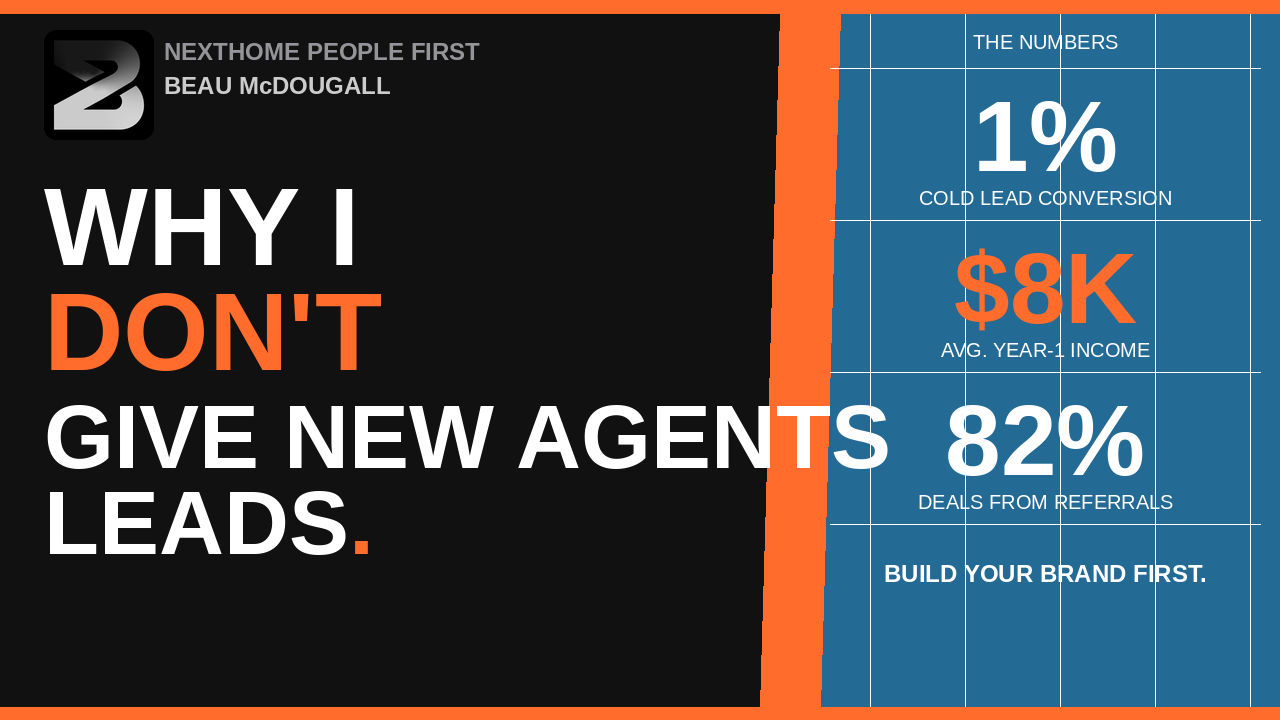
The most common question I get from agents considering joining our brokerage is: “Do you provide leads?”
My answer is always the same: No.
And every time I say it, I watch the person across from me shift in their seat. Some look disappointed. A few have walked out the door. But the agents who stay and listen (the ones who actually build sustainable careers) eventually come back and tell me it was the best piece of advice they ever received.
Here’s exactly why I hold that position, backed by data, and what I tell every new agent who walks through my door instead.
The Lead Myth New Agents Believe
There’s a fantasy that gets sold to new real estate agents before they even get their license: get leads, get clients, make money. Simple pipeline, right?
Wrong.
The real estate industry has a lead conversion problem that most brokerages don’t want to talk about honestly. Industry-wide conversion rates for real estate leads average just 0.4% to 1.2%. Read that again. Out of every 1,000 leads, the average agent converts between 4 and 12 of them into closed transactions.
And that’s for seasoned agents, people who know the contracts, the market, the language, the objection handlers, the financing nuances. They’ve been through the fire. They know how to build rapport over a 12-month follow-up sequence without coming across as desperate.
For a brand-new agent? Those numbers get worse. Much worse.
What the Data Actually Says About New Agent Performance
Let’s be honest about where new agents actually stand before we talk about handing them a phone and a list of strangers to call.
According to NAR’s 2025 Member Profile, agents with two years or less experience earned a median income of just $8,100 in 2024, and closed a median of only 3 transactions. Compare that to agents with 6 to 15 years of experience, who closed a median of 11 transactions. The gap isn’t a matter of effort, it’s a matter of knowledge, skill, and credibility.
NAR data shows that 62% of agents with two years or less of experience made under $10,000 in their first year, before expenses. After you factor in MLS dues, marketing costs, gas, and licensing fees, most new agents are operating at a loss.
The median first-year Realtor in America earned $8,100 in gross income in 2024. After expenses like NAR and MLS dues, signs, photography, and lead spend, the typical new agent is operating at a loss for 12 to 24 months.
Here’s what that looks like in real terms: if a new agent closes one deal at $500K with a 2.5% commission, that’s $12,500 gross. After a brokerage split, they might take home $5,500, and that has to cover months of costs. If they’ve been burning through money buying leads in the meantime, they may not even break even.
And critically: new agents received 0% of business from repeat clients and 0% from referrals in 2024. Every single deal they close has to be earned cold, which is the hardest, most expensive, most time-consuming way to build a business.
The Real Problem With Giving New Agents Leads
Here’s the core issue, and I say this with full respect for every new agent who has ever walked into my office excited and eager:
You don’t yet know how to talk real estate.
That’s not an insult. It’s a fact of the learning curve, and it applies to every agent, including me when I started. Real estate has its own language. Disclosures, contingencies, earnest money, appreciation, cap rates, 1031 exchanges, appraisal gaps, these aren’t just vocabulary words. They’re concepts that have legal and financial consequences when used incorrectly. And when you’re on the phone with a stranger who is trusting you to guide one of the largest financial decisions of their life, that gap in knowledge can cause real harm.
New agents can unintentionally misrepresent a property, overpromise on timelines, or fail to properly explain contract terms, not out of dishonesty, but out of inexperience. In a world where every prospect will Google you before they ever pick up the phone, that kind of misstep doesn’t just cost you a deal. It can cost you your reputation and potentially your license.
You also haven’t built your credibility online yet.
When a stranger receives your call or finds your card, the first thing they do is look you up. They check your website. They look at your social media. They count your reviews. They look at how long you’ve been in business. If what they find is a blank LinkedIn profile, a sparse Instagram page, and zero testimonials, they move on. In 2025, your digital footprint is your first impression, and most new agents haven’t built one yet.
Handing cold leads to an agent in that position isn’t opportunity, it’s waste. It wastes the leads. It wastes the agent’s money. And worse, it demoralizes them when conversion doesn’t happen, making them question whether they’re cut out for this business at all.
The Cold Calling Reality Check
Here’s what the sales data says about cold calling in general, before we even get to real estate-specific numbers:
The average success rate for cold calling is 4.82%, with sales representatives making an average of 330 cold calls per appointment. 85% of the market’s available business goes to just 5% of sales representatives who conduct successful cold calls.
And those numbers apply to trained salespeople in industries where the product costs thousands of dollars, not hundreds of thousands.
In real estate specifically: cold calls in high-ticket categories (products over $1 million) see conversion rates drop below 1.2%, requiring 85 or more calls to close a single deal. Real estate in most U.S. markets qualifies as a high-ticket transaction.
The typical cold call conversion rate sits between 2 and 3%. That means out of every 100 calls, you’re looking at roughly 2 to 3 qualified next steps. For a seasoned pro, that’s manageable. For someone still learning how to explain a purchase agreement? Those numbers crater.
Now consider what it costs to get those leads in the first place. The average cost per lead using Google Ads for real estate is $66.02, and the cost of acquiring new leads has increased 50% over the past five years. If your conversion rate is 1% and you’re paying $66 per lead, you need 100 leads to close one deal, that’s $6,600 in lead spend alone for a single transaction, before your time and other overhead.
The math simply doesn’t work for new agents. Not yet.
Where New Agents Should Actually Start: The SOI Advantage
Your Sphere of Influence (friends, family, former colleagues, neighbors, classmates, your dentist, your gym buddy) is the most powerful and most underutilized resource in a new agent’s career.
According to a study by Buffini & Company, 82% of all real estate transactions come from referrals, repeat business, or personal contacts, in stark contrast to the much lower conversion rates seen with cold leads, where the average conversion rate is just 1% to 3%.
According to NAR data, 41% of buyers and 63% of sellers choose their agent based on a referral or prior relationship, while online leads from Zillow and Realtor.com convert at under 2%.
Think about what this means practically. Your SOI doesn’t need to be sold on your credibility, they already believe in you as a person. They’re not going to Google your transaction history or count your Zillow reviews. They want to see you succeed. And when you make an honest mistake (when you stumble on an answer or have to say “let me get back to you on that”) they will forgive it in a way that a cold stranger never would.
That forgiveness is priceless when you’re still learning.
Referral leads are more likely to convert and typically require 82% less follow-up time than cold leads. Less time chasing, more time closing. That’s the model that keeps new agents financially afloat while they build their skills.
Referrals from your sphere of influence consistently outperform cold leads on cost, conversion rate, and lifetime value.
Why We Have a Step-by-Step Process Before You Touch Cold Leads
This is why our brokerage has a defined onboarding path for new agents. It’s not bureaucracy, it’s protection. Protection for you, for your clients, and for the profession.
Before any of our new agents start cold calling or purchasing leads, we work through a structured progression:
Step 1: Learn the Language
You need to be able to speak fluently about the transaction process, contract terms, financing options, and local market dynamics before you’re in front of strangers. We train until you’re comfortable, not just test-passing, but genuinely fluent.
Step 2: Build Your Digital Presence
Your personal brand needs to exist before you go outbound. That means a professional social media presence, a bio that establishes who you are, and ideally some content that demonstrates your knowledge. This doesn’t have to be elaborate, but it must be there. When someone searches your name, they need to find something that builds trust.
Step 3: Work Your SOI
Your warmest, most forgiving, most willing-to-refer audience is right in front of you. Your friends and family want you to win. Your first transactions will come from people who know you. Those deals build your confidence, your competence, your reviews, and your referral network.
Step 4: Earn Your Testimonials
Before you ask strangers to trust you, you need proof that you’ve helped people. A handful of five-star reviews from real clients changes everything about how cold outreach is received.
Step 5: Then (and only then) do we add cold outreach
We discuss adding cold outreach and purchased leads to your business only after you’ve completed steps 1 through 4. By that point, you know the language, have a track record, and have the skills to actually serve those leads well.
The Long Game Always Wins
The agents who skip this process and go straight to cold lead generation often quit within the first year. Roughly 75% of newly licensed real estate agents leave the industry within their first year, and 87% are out within five years. That’s not a talent problem. That’s a sequence problem. They try to run before they can walk, get discouraged by brutal conversion rates, burn through their savings, and conclude that real estate doesn’t work, when really, the approach didn’t work.
The agents who build their foundation first (who take the time to develop their personal brand, serve their sphere authentically, and earn their first clients through relationships) are the ones who are still here five and ten years later, building a referral engine that generates business without a monthly ad spend.
NAR data shows that agents making more than $100,000 a year get nearly one-third of their business from referrals from past clients and 34% from repeat business. That’s not a coincidence. That’s what the long game looks like.
Frequently Asked Questions
Why don’t most brokerages tell new agents this?
Because providing leads is a revenue model. Lead generation is a multi-billion-dollar industry, and many brokerages profit from selling or charging for leads. Our position is different: we’d rather help you build a career that lasts than generate short-term revenue from leads you’re not ready to convert.
How long does it take before a new agent is ready for cold leads?
It varies, but in our experience, most agents need 6 to 12 months of active practice (completing at least a few transactions, building their digital presence, and growing comfortable with the full transaction process) before cold outreach becomes worth the investment.
What if I already have a strong sales background?
Sales skills absolutely help. But real estate has specific compliance, legal, and disclosure requirements that sales experience from other industries doesn’t cover. The onboarding process still applies, it just moves faster for people who already understand relationship-building and pipeline management.
Does focusing on SOI mean I can’t grow quickly?
No. In fact, SOI-first growth tends to be faster and more sustainable in the first 12 to 18 months than cold lead pursuit. Referrals close faster, cost less to acquire, and generate more referrals. The “slow” path is actually the fast path.
What if I don’t have a large SOI?
Everyone has more people in their sphere than they think. Most agents have 200 to 500 people they know by name. The work is identifying them, organizing them, and staying in consistent, value-first contact. We help with that.
Is this brokerage right for part-time agents?
Our model works for part-time agents, but with an important caveat: the fundamentals still apply. You need to learn the language, build your presence, and work your sphere, it just takes longer when you’re doing it part-time. We’ve seen part-time agents build strong SOI-based businesses over 18 to 24 months. What we’ve rarely seen succeed is a part-time agent trying to work cold leads. The follow-up cadence required is simply too time-intensive when real estate isn’t your primary focus.
How do I know when I’m actually ready to start buying leads?
You’ll know you’re ready when three things are true: you can walk a client through a full transaction without needing to look up every answer, you have at least a few closed deals and some online reviews to show for it, and you have a consistent follow-up system in place. If you’re still learning the basics, leads will cost you money and confidence. Once you’ve got your foundation, the same lead spend produces dramatically better returns.
What does your onboarding process actually look like week-by-week?
The first 30 days focus entirely on education, contract literacy, local market knowledge, financing fundamentals, and disclosure requirements. Days 31 through 60 shift toward brand-building: we help you set up your digital presence, craft your bio, and map out your sphere. From there, we move into active SOI outreach, how to reach out without being awkward, how to ask for referrals authentically, and how to stay top-of-mind without spamming people. Cold lead strategies come later, once you have real results to stand behind.
Can I still do open houses while I’m building my foundation?
Absolutely, and we encourage it. Open houses are one of the best training grounds for new agents. They give you real conversations with real buyers in a low-pressure setting, help you practice explaining properties and neighborhoods, and occasionally produce direct clients or referrals. They’re also one of the few lead-generation activities where your inexperience is less of a liability, because buyers at open houses are evaluating the home first and you second. Use that window.
What’s the biggest mistake you see new agents make in their first year?
Spending money before they’re ready to convert it. Whether it’s buying leads, running ads, or paying for a fancy CRM they don’t know how to use, the most common pattern we see is new agents burning through capital on tools and tactics before they’ve built the skills to make those tools work. The second-biggest mistake is avoiding their sphere out of fear of embarrassment. Most new agents don’t want to “bother” their friends and family. In reality, those people are rooting for you and waiting to hear from you. Don’t make them find another agent.
The Bottom Line
When you ask me if we provide leads, and I say no, I’m not turning you away. I’m protecting your future.
The agents who build their foundation first (who invest the time in their education, their personal brand, and their sphere) are the agents who are still in this industry a decade from now. They’re the ones who build teams, open their own brokerages, and become the people new agents come to for advice.
That’s what I want for every agent who comes through our door.
And that’s why the answer is no.
Ready to build a real estate career that actually lasts? Let’s talk about whether our brokerage is the right fit for where you want to go.
🏡 More Las Vegas Real Estate Guides
Explore agent insights, market strategies, and real estate resources all in one place. Visit the Las Vegas Real Estate Hub →